INTRODUCTION TO RHYTHM GUITAR


INTRODUCTION TO RHYTHM GUITAR |
|
|
Do get yourself a good guitar – it should have a good sound, and be easy to push the strings down and play clear notes. Most people start with a nylon stringed classical guitar, a new one will cost between 1-2 day's wages. A steel stringed acoustic guitar will cost twice that for a reasonable one, and an electric guitar requires leads and amps as well. They all use the same notes and chords. Find a good guitarist to help you choose both a new or a secondhand guitar - some problems can be fixed, but a faulty guitar will dishearten anyone.
STRINGS…...
- They really all need replacing every three to six months or so, as old strings sound dull and go out of tune quickly, as do very cheap strings. It takes 2-3 days for the strings to stretch, so they will need tuning and playing a lot at first. Advice and help with these things from a good guitarist is invaluable. It may take up to a month before a beginner can make a good, clear sound - you don't need extra problems to discourage you.
- For wide necked guitars - for folk and classical music - use nylon strings. These are softer, both in volume and on the fingers. Martin or Augustine strings are usually good.
- Narrow necked guitars have a stronger, metallic sound, - and are harder on the finger tips at first. D’Addario or Martin are good string brands - try light gauge steel strings
| ABOUT THE GUITAR |
|
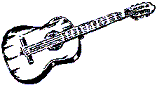 |
The guitar was invented in Spain during the 16th century, but guitar-like instruments have existed since ancient times. It has many features that make it a most valuable music instrument. It is strongest as a rhythm accompaniment to other music, but so versatile that a melody can be played on the same instrument, at the same time. It is capable of being used for an enormous number of styles from classical to the latest pop tunes. Its portability and reasonable price means it is played all over the world.
Many people would like to be able to play this wonderful instrument. Most people are happy to learn to play chords to sing to, but a great majority of books and teaching methods insist upon pupils learning to read music notation, or difficult techniques. The beginning pupil is expected to learn a great deal and acquire many skills before anything of interest can be played. But the method in this book has pupils playing real music from the first lesson.
There is no denying it does hurt a bit at first, as the finger tips toughen up. This happens quite soon with practice, at least 5 minutes a day, 2-3 times at first, and the reward is being able to make a good sound quickly. By the third lesson, with just three chords, many popular songs will be able to be played, and each new skill learnt adds to the range of things that can be done with the instrument. The extension pages give further skills such as bar chords, bass and finger picking, and different strums.
The method is designed to be a springboard to learning whatever style of music the student desires to go on to.