READING THE CHORD CHARTS
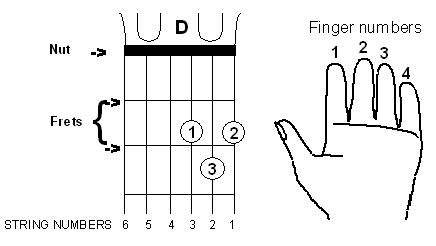
A chord diagram is a `bird's-eye' view of the fingerboard:- vertical lines represent the six guitar strings, with the thick, lowest sounding string on the left of the diagram, and the highest sounding one on the right. FRETS are the metal strips across the fingerboard of the guitar. The lines across represent the frets and the numbered circles show which finger goes on which string.
The letter above is the name of the chord being played. The guitar can be played the same way by left and right handed people, as both hands are used; alternatively, both strings and chord shapes can be reversed, but this means you can‘t usually play other guitars...
Your fingertips will be sore at first, until practice makes the tips of your fingers harder – play five minutes, often. You can also work without a guitar; e.g. squeeze a soft ball, to make your fingers strong, and press a soft corner like a table edge to make the skin thicker.
HOW MUCH TO PRACTICE
Teaching your brain something new is like making a path through long grass - there are so many ways to go - repeating the same steps often is the way...
With guitar practice - five minutes, twice a day is much better than an hour before you get to your lesson. Keep your guitar somewhere handy, so it's easy to pick up... [Play during advertising on TV is ideal]. For fast progress, make it an enjoyable and regular twenty minutes most days. Be patient with yourself, work on difficult bits for a five minutes at a time, and they’ll come right soon. Watch and talk to good players, and encourage yourself with how much you have learnt already!